Note: This works best with a screen resolution of 1024x768. See note at bottom. ![[Image: Small smiley face]](smiley.gif)
.
For details on the situation described below, check out Psychoactive Rebound
.
.
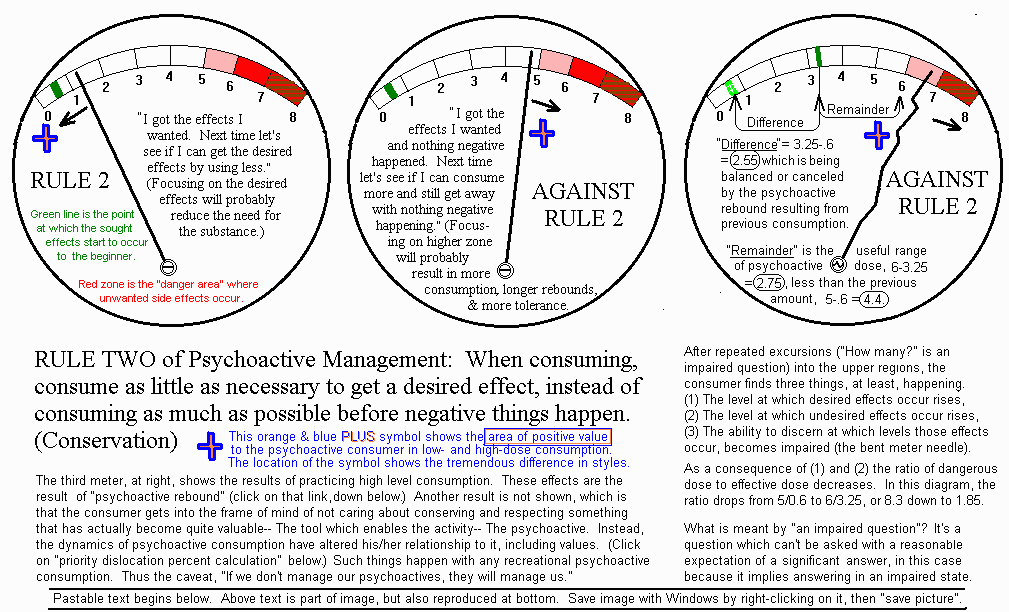
Meter #1 showing needle falling toward "+" (area valued by consumer) to the left:
RULE 2 "I got the effects I wanted. Next time let's see if I can get the desired effects by using less." (Focusing on the desired effects will probably reduce the need for the substance.) Green line is the point at which the sought effects start to occur for the beginner.(*Footnote 1) Red zone is the "danger area" where unwanted side effects occur.
Meter #2 showing needle rising toward "+" (area valued by consumer) to the right:
AGAINST RULE 2 "I got the effects I wanted and nothing negative happened. Next time let's see if I can consume more and still get away with nothing negative happening." (Focusing on higher zone will probably result in more consumption, longer rebounds, and more tolerance.) Notice what happens to the danger zone in the next meter----> (*Footnote 2)
Meter #3 showing needle rising toward "+" (area valued by consumer) to the right, now in the red danger zone:
AGAINST RULE 2 "Am I having fun yet?" (* Footnote 3) "Difference" and "remainder" areas shown. "Difference" = 3.25 - 6 = 2.55 which is being balanced or canceled by the psychoactive rebound resulting from previous consumption. "Remainder" is the useful range of psychoactive dose, 6 - 3.25 = 2.75, less than the previous amount, 5 - 0.6 = 4.4.
RULE TWO of Psychoactive Management: When consuming, consume as little as necessary to get a desired effect, instead of consuming as much as possible before negative things happen. (Conservation) This orange and blue PLUS symbol shows the area of positive value to the psychoactive consumer in low- and high-dose consumption. The location of the symbol shows the tremendous difference in styles.
After repeated excursions ("How many?" is an impaired question) into the upper regions, the consumer finds three things, at least, happening:
(1) The level at which desired effects occur rises,
(2) The level at which undesired effects occur rises,
(3) The ability to discern at which levels those effects occur, becomes impaired (the bent meter needle).
As a consequence of (1) and (2), the ratio of dangerous dose to effective dose decreases. In this diagram, the ratio drops from 5 / 0.6 to 6 / 3.5, or 8.3 down to 1.85.
What is meant by "an impaired question"? It's a question which can't be asked with a reasonable expectation of a significant answer, in this case because it imples answering in an impaired state.... Save image with Windows by right-clicking on it, then left-click on "save picture".
------------------------
Footnotes (not embedded in picture)
1-- The beginner notices effects starting at the green line. Experienced Rule-2-consumers will notice those effects lower on the scale. Someone consuming at high levels will notice effects happening higher and higher on the scale, and use more to achieve them, thus driving up the point at which they occur.
2-- The danger zone in the third meter is smaller, meaning that the consumer has developed a tolerance to some of the high-end effects. But, although the less-dangerous pink zone shrinks, yet the deadly part of the danger zone remains the same. Thus, the high level consumer is operating closer and closer to a steeper and steeper cliff.
3-- "Am I having fun yet?" applies to the low-level consumer also, but the low-level consumer, because of less impairment, will have a better chance of getting an accurate answer to the question.
----------------------------------------------
Comment-- L sent me email this morning (7-25-0) with a URL to a Web page depiciting the world's population as 100 people. I responded with a comment that led me to a thought about Psychoactive Management. Here's my comment on the "100 people" idea.
I wonder what the standard of living is based on, in several of those comments. I wonder how people who are impoverished and illiterate and otherwise disadvantaged, see the ones ABOVE them on various scales. I think that, when you're looking at people above you on a scale, things get very blurred and hard to see. Underneath, one can make distinctions and calculations. Above, it's hard to get a sense of a scale. I think that's part of the problem in learning to drink or use psychoactives at a high level. In aiming for the higher levels, one has an indistinct picture of what is involved, whereas it is easier to see what is involved at lower levels. I will use this email and the link you sent, in my discussion at "rule2meters.html". (END of email note to L.)
Join the Yahoo!groups email loop, The5Rules, at http://groups.yahoo.com/group/the5rules
To change resolution setting, with a PC: Click on Start/Settings/Control Panel/Display/Settings and move the slider. 1024x768 is best for this page.